
Know-how
The egg and nutrition
Always within an arm’s reach, the egg is a constant source of energy, a comforting ingredient, the promise of a healthier life.
A Large egg contains 6.5 grams of protein and 14 important nutrients: vitamins A, D and E, folate, iron and zinc. Because it contains all 9 essential amino acids, the egg is one of the few foods recognized as a complete protein.
Outside
Inside
0 g of sugar, 0 g of carbohydrates, 70 mg of sodium: it’s all in the shell!
The shell: a naturally porous barrier that gets thinner as the hen ages
The yolk: vitamins A, D, E, B12, iron, unsaturated fats (including omega-3) and antioxidants
The white: 90% water, some of the egg’s protein and no fat.
The anatomy of an egg
Explore the egg inside and out, and discover everything a single large egg has to offer.
1.5 grams of saturated fat
70 calories
0 grams of sugar
6 grams of protein
185 milligrams of cholesterol
2 grams of monounsaturated fat
1 gram of polyunsaturated fat
70 milligrams of sodium
0 grams of carbohydrate
5 grams of fat
6% vitamin D
2% calcium
6% iron
2% potassium
15% riboflavin
15% vitamin B12
35% biotin
20% pantothenic acid
20% iodine
25% selenium
25% molybdenum
Egg white
- Source of protein
- Little to no carbohydrates
- No fat
- No cholesterol
- Very light, delicate taste
- Varied textures (airy, gel, elastic)
Egg yolk
- Source of several vitamins (A, D, E, B12) and iron
- “Umami” taste
- Creamy texture
- Source of omega-3 (enriched eggs)
Did you know?
The egg yolk is packed with nutrients. It’s also where you’ll find the added omega-3s in Lovo’s enriched eggs. Eating the whole egg allows you to enjoy its full nutritional benefits.
The colour of the yolk is influenced in part by carotenoids, natural pigments found in certain plants and ingredients in a hen’s diet.
From the farm
to your plate

6
Coding, packing and delivery
The last step is packing the eggs into cartons of various sizes. The cartons are coded to make the eggs easy to trace (grading facility number, expiry date), then delivered to the customer.

5
Sizing the eggs
Each egg is weighed and sorted by size: Small, Medium, Large, Extra Large or Jumbo.

4
Candling the eggs
This technique uses beams of light to look inside the egg and identify any defects.

3
Washing and drying the eggs
After inspection, the eggshells are washed and dried.

2
Receiving the eggs at the facility and checking their quality
As soon as they arrive at the grading facility, the eggs are assessed for quality (weight, yolk colour, condition of the white, shell thickness). Damaged eggs are removed.

1
Collecting the eggs at the farm
The first step is picking up the eggs at the farm and bringing them to the grading station.
Why do eggs come in different sizes?
The main reason is the hen’s age. Younger hens generally lay smaller eggs, while more mature hens produce larger ones.
Eggs are then graded by weight rather than by size or shape. Most eggs sold in grocery stores are classified as Large or X-Large.

Small
42 g to less than 49 g
Medium
49 g to less than 56 g
Large
56 g to less than 63 g
Extra Large
63 g to less than 70 g
Jumbo
70 g and over
Traceability of fresh shell eggs
Traceability is essential to building trust. It allows each egg’s journey to be tracked from the farm to your table, with its history available at any time. At Lovo, this transparency is made possible through a coding system printed directly on the egg or its packaging.
Why is there a code on the shell?

Lovo’s grading stations in Quebec print a code on the shell of the eggs to make them easier to trace. Among other things, this code indicates the grading station and the farm of origin. To find out which farm, visit the Quebec Egg Producers Federation website.
Nothing on the shell?

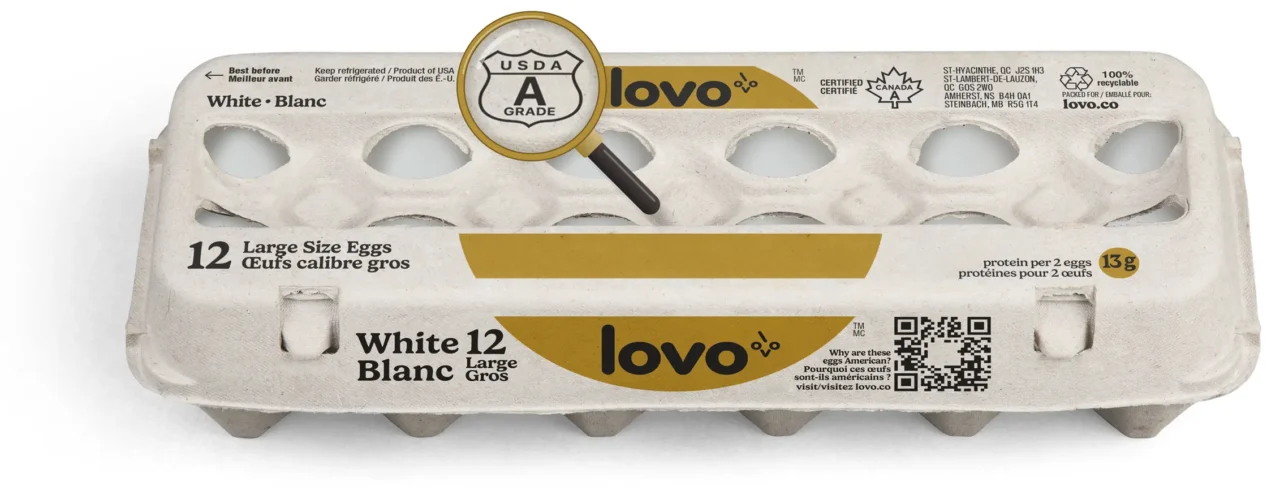
An egg without a code may have been produced in another Canadian province or in the United States. For American eggs, the origin is indicated on the packaging.
Why is there a code on the packaging?
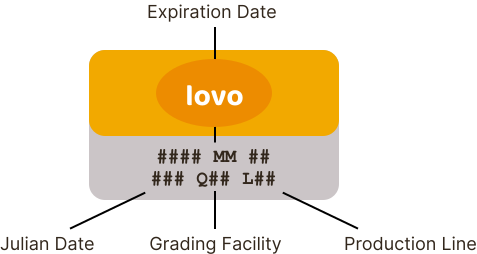
All Lovo grading facilities also label cartons of 6, 12 and 18 eggs, as well as their shipping cases.
Why are there American eggs in Canada?
Canada has signed international trade agreements, including CUSMA, that allow a limited volume of foreign eggs to be imported. Today, those imports account for roughly 5 to 6 % of the Canadian market, while the vast majority of eggs consumed here come from Canadian farms.
At Lovo, we work every day to apply the rules set by the federal authorities. So when a product contains eggs from the United States, its origin must be identified in accordance with the requirements of the Canadian Food Inspection Agency (CFIA).
Lovo is committed to providing clear information about where its products come from, while continuing to support Canada’s supply management system and our farmer-owner families.
Looking for more information?
Canadian Food Inspection Agency (CFIA).
Import requirements for eggs and processed egg products.
Canadian Food Inspection Agency (CFIA).
Labelling requirements for shell eggs.
United States Department of Agriculture (USDA).
Shell Egg Export Requirements for Canada.
Canadian Food Inspection Agency (CFIA).
Canadian Grade Compendium — Canada A grade.
And what about the hens behind it all?
Housing, feed and care: discover how our farmers look after their hens.